 中央研究院 生物化學研究所
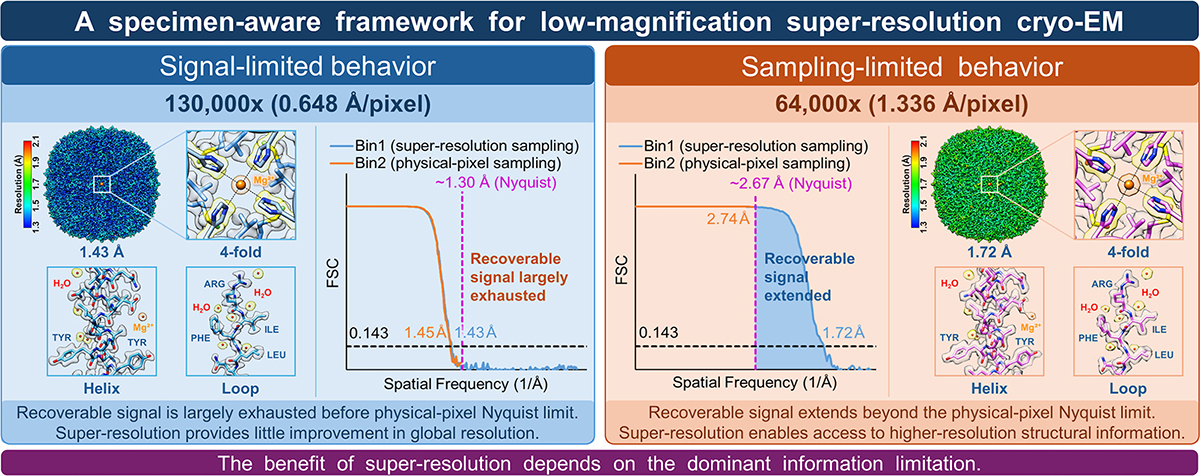
Single-particle cryo-EM routinely delivers near-atomic structures; however, optimizing data collection requires a delicate balance among magnification, sampling bandwidth, and particle throughput. Although low-magnification super-resolution imaging can recover information beyond the physical-pixel Nyquist limit, its benefit varies substantially among specimens. This variability suggests that the effectiveness of super-resolution may depend on whether reconstruction is limited by detector sampling bandwidth or by the recoverable particle signal. However, the conditions that distinguish these two regimes remain poorly defined. Here, we systematically compared super-resolution and physical-pixel workflows at two magnifications using apoferritin (APO) and malate synthase G (MSG) as representative specimens with contrasting molecular size, symmetry, and image contrast. At low magnification, APO exhibited sampling-limited behavior, with super-resolution processing reaching 1.72 Å, whereas the Fourier-cropped Bin2 workflow yielded a CryoSPARC-reported value of 2.74 Å, close to the physical-pixel Nyquist limit. In contrast, MSG exhibited predominantly signal-limited behavior under the same conditions, yielding comparable resolutions of 3.05 Å and 3.00 Å for super-resolution and physical-pixel processing, respectively, despite the increased sampling bandwidth. These contrasting responses were further supported by particle-number saturation, per-particle motion correction, and Q-score analyses, which provided complementary evidence for interpreting the observed sampling- and signal-limited behavior. Together, these results provide a practical framework for assessing whether reconstruction quality is predominantly constrained by sampling bandwidth or recoverable particle signal and offer a rational basis for balancing achievable resolution and particle throughput when selecting acquisition strategies.