 中央研究院 生物化學研究所
中央研究院 生物化學研究所
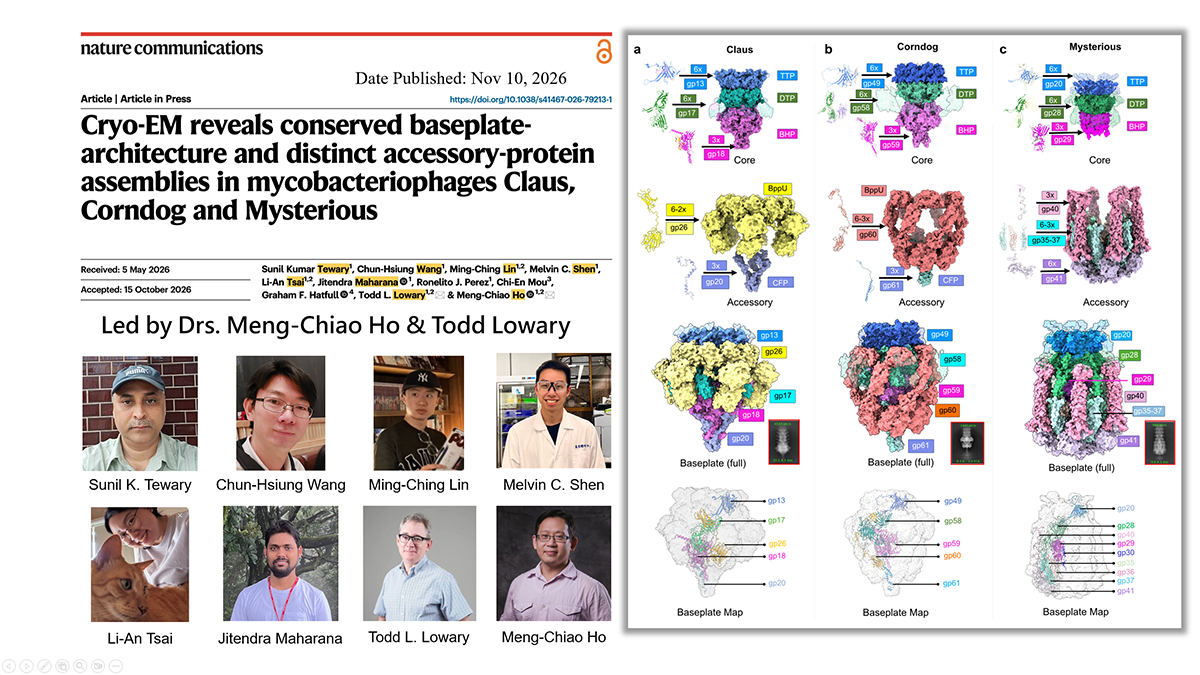
Mycobacteriophages, viruses infecting mycobacteria, hold therapeutic promise against antibiotic-resistant mycobacterial infections. Although thousands of mycobacteriophages have been isolated, high-resolution baseplate structures have been reported for only two, highlighting a gap in understanding phage–host interactions. Most mycobacteriophages are siphophages with four structural components: capsid, connector, non-contractile tail, and baseplate. The baseplate plays a critical role in host recognition, adsorption, and genome delivery. Here, we present atomic-resolution cryo-EM baseplate structures of three mycobacteriophages, Claus, Corndog, and Mysterious. These exhibit distinct inverted crown-, barrel-, and cage-like architectures, respectively, yet share a conserved architecture with a 6:6:3 stoichiometry of homohexameric tail tube proteins (TTPs), distal tail proteins (DTPs), and homotrimeric baseplate hub proteins (BHPs). The baseplate core is formed by DTPs and BHPs, with terminal TTPs making direct proximal contacts with DTPs and contributing to overall structure. While the central core is conserved, the exterior domains diverge across the phages. Surrounding the conserved cores are diverse baseplate accessory proteins (BAPs), including upper baseplate proteins (BppUs), central fiber proteins (CFPs), and others, which assemble into distinct peripheral architectures and give rise to two baseplate-opening mechanisms. These structures reveal a conserved baseplate core complex diversified by BAPs, a feature potentially shared across mycobacteriophage siphophage families.