 中央研究院 生物化學研究所
中央研究院 生物化學研究所
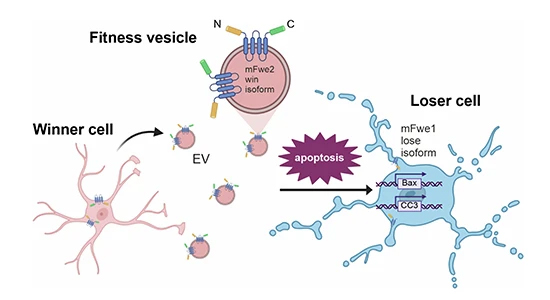
Cellular fitness surveillance preserves tissue integrity by eliminating less-fit cells, yet its regulation within the complex glial networks of the mammalian brain remains poorly understood. Here, we identify a dual-domain mechanism in the transmembrane protein Flower-which encodes survival-promoting ("win") and apoptosis-inducing ("lose") isoforms-that enables non-contact-dependent fitness signaling in astrocytes. We show that astrocytes release extracellular vesicles (EVs) carrying full-length Flower, allowing for intercellular surveillance between distant cells. The shared N-terminal domain acts extrinsically via EVs to drive the elimination of distal, less-fit cells. In contrast, the C-terminal domain,exclusive to the win isoform,functions intrinsically independent of EV transport; it translocates to the nucleus to downregulate caspase-3 and enhance survival. In APP-transgenic mice and human Alzheimer's disease brains, Flower-positive astrocytes accumulate around amyloid-β plaques. Under amyloid-β stress, the win isoform promotes a neuroprotective reactive state that enhances plaque clearance. Our findings reveal how Flower couples EV-mediated attack signals with intrinsic nuclear protection to coordinate astrocyte quality control and tissue resilience in neurodegeneration.